S6.D5. Tight night. Framing Problems, Shipping Experiments
Day 5 of Hack A Business S6 - Five student-led presentations

Same brief: find a real problem, analyze with VUCA, propose solutions, flag SDG impact.
Last night’s Hacker Business Season 6 finale was a lively mash-up of student curiosity, local knowledge, and scrappy solutioning. Presenters ran through small-business case studies and social projects using the VUCA framework (volatility, uncertainty, complexity, ambiguity) and tied their recommendations to SDGs — a smart pedagogical move. Below I break down each presenter’s performance with praise, pointed critique, and practical next steps they can act on fast.
Section 1 — Welcome
Last night’s Hacker Business Season 6 — Final Presentation Day delivered a compact, high-energy run of student projects that married local knowledge with problem-solving frameworks (VUCA + SDGs). MIHF ran a tidy session: translations available, evaluation forms live in chat, and a 30-minute behind-the-scenes debrief for participants. Season 7 starts October 10, 2025 — a reminder to convert last night’s ideas into measurable pilots before then.
Section 2 — Presentations (five member recaps — decodable, critical, and actionable)
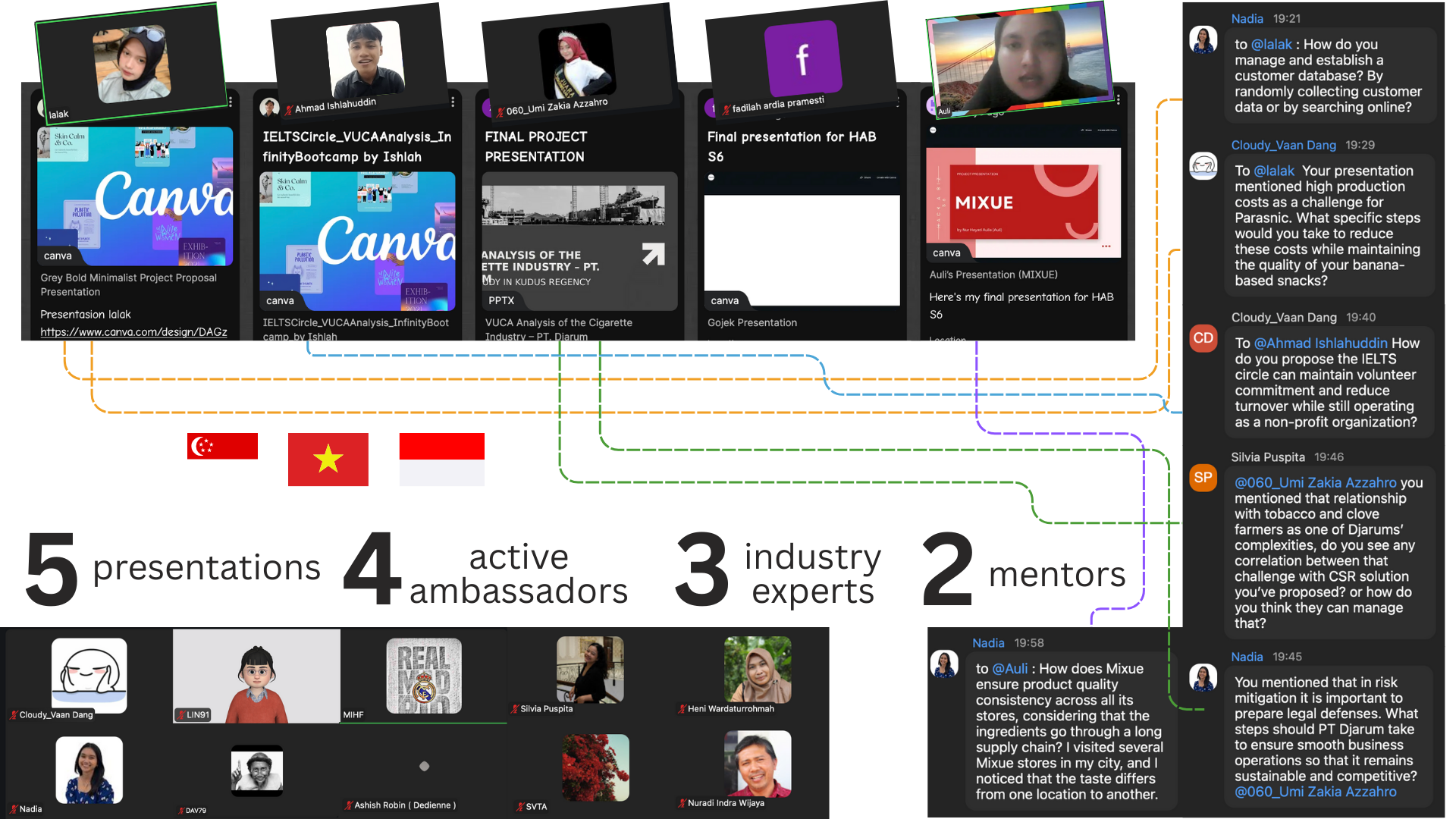
1) Parasnic — Lalak
Discussion title: Fix the banana gap before you scale the flavor parade.
Energy & moment: brisk, slide-ready, answered immediately — attempt to respond to some questions asked by ambassador
What worked: Tight VUCA structure; clear SDG tie to local sourcing → rural income.
Where it fell short: Delivery raced ahead of clarity; implementation details skimmed; some pronunciation blurred meaning. . Impact claims were plausible but unquantified.
Quick score: 6 / 10
2) IELTS Circle — Ahmad Ishlahuddin
Discussion title: From flyer-info to measurable outcomes — making volunteer teaching stick.
Energy & moment: open camera, well prepared and the most energetic among all, earnest; used lived context (Indonesia); proposed short/medium/long tactics.
What worked: Clear triad (shallow content; few professionals; volunteer churn); stakeholder-aware, not still somehow on the surface level
Where it fell short: No monetization test to stabilize volunteers; sparse metrics/KPIs, The plan is pedagogically solid but light on operational minor detail and incentives. Volunteer turnover and unclear outcomes are recognized — good — but the presentation didn’t give a concrete/ sustainable retention playbook or clear metrics for “improved English proficiency.” Narrow view on the given points
Quick score: 7 / 10
3) Cigarette Industry (PT Jerom-style case) — Umi Zakia
Discussion title: When local livelihoods clash with public health: a regulatory tightrope.
Energy & moment: reflective and community-aware; honest about trade-offs.
What worked: Solid stakeholder map (farmers, factories, tax, labor); realistic recommendations (legal compliance, diversification).
Where it fell short: Missed a solutions slide initially; This topic sits at the intersection of economics and public health. The presentation could have been stronger by more explicitly addressing the ethical and long-term social costs (health + environment) and offering concrete alternatives for farmers (crop substitution or processing diversification).
Quick score: 6 / 10
4) Gojek (super app) — Fadilah Ardia Pramesti
Discussion title: Super app, super risks — tighten incentives, tighten trust.
Energy & moment: confident, professional, compact.
What worked: Clear risk identification (competition, regulation, data security, driver welfare) and clean SDG mapping (jobs, infrastructure, green mobility).
Where it fell short: Recommendations remained strategic rather than operational — missing example pilots and partner dynamics.
=> Good executive summary; needs an operational prototype to convince operators/regulators. To move from good to great, add financial targets and an implementation roadmap for partner welfare (drivers’ incentives, healthcare…) and EV adoption (cost, rollout plan, timeline).
Quick score: 7.0 / 10
5) Mishue (Mishui ice cream) — Auli
Discussion title: Viral product, fragile moat — turn curiosity into loyalty.
Energy & moment: enthusiastic, slightly nervous, very local.
What worked: Strong contextual details (halal certification, imported inputs), thoughtful SDG picks (jobs, responsible consumption). You correctly flagged supply-chain fragility, fast-moving consumer trends, competition and regulatory ambiguity (halal certification).
Where it fell short: Repetitive phrasing, the heart of the strategy (product diversification + supply chain fixes) is right — but it needs market evidence and clearer product/price experiments. Also: health/sustainability proposals would be stronger with concrete recipes (e.g., sugar-reduction targets) and packaging alternatives. => Viral curiosity is real; convert it to repeat buyers with quick experiments.
Quick score: 6.5 / 10
Section 3 — Voice of the Audience (high-value feedback & quotes)
Guests and community partners reinforced the program’s value and added practical perspective:
Heni (Mata Aksara): applauded the literacy and mindset work — she will publicize the program among Yogyakarta students and families; emphasized the link to child and family literacy.
Nuradi Indra Wijaya: praised critical thinking and cross-literacy (digital, financial, science), and noted the program’s potential to translate civic problems into English-framed discussions.
Ashish Robin: encouraged presenters to keep iterating ideas and commended actionable suggestions for company improvements.
Audience takeaways
Always attach one measurable outcome to each recommendation.
Show at least one micro-pilot or user test before the next season.
Use plain language for non-technical stakeholders (funders, local officials).
Section 4 — Behind the Stage (logistics, facilitation notes, and What’s next)
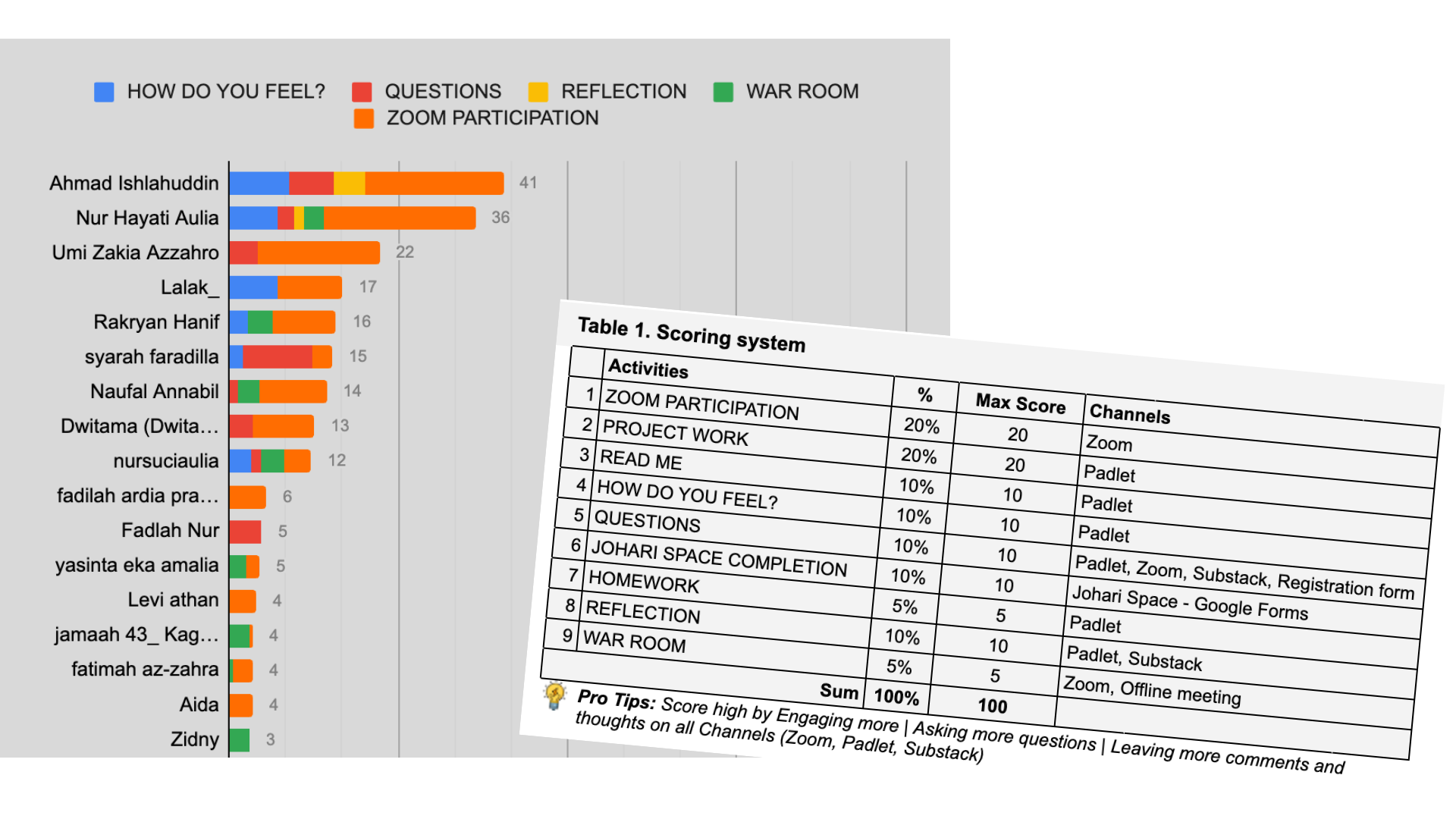
Facilitation — MIHF: kept the program moving and audience onboarding clear (evaluation form, translations, frameworks). All members are reminded of their current score - which seems to fall short, despite the fact that they are already at the last part of the program. Few critical to-dos are required to get their Performance Report