
02. QUESTIONS ARE US...
so members are sending in the questions and that's already interesting.

EARLIER….

More Questions….
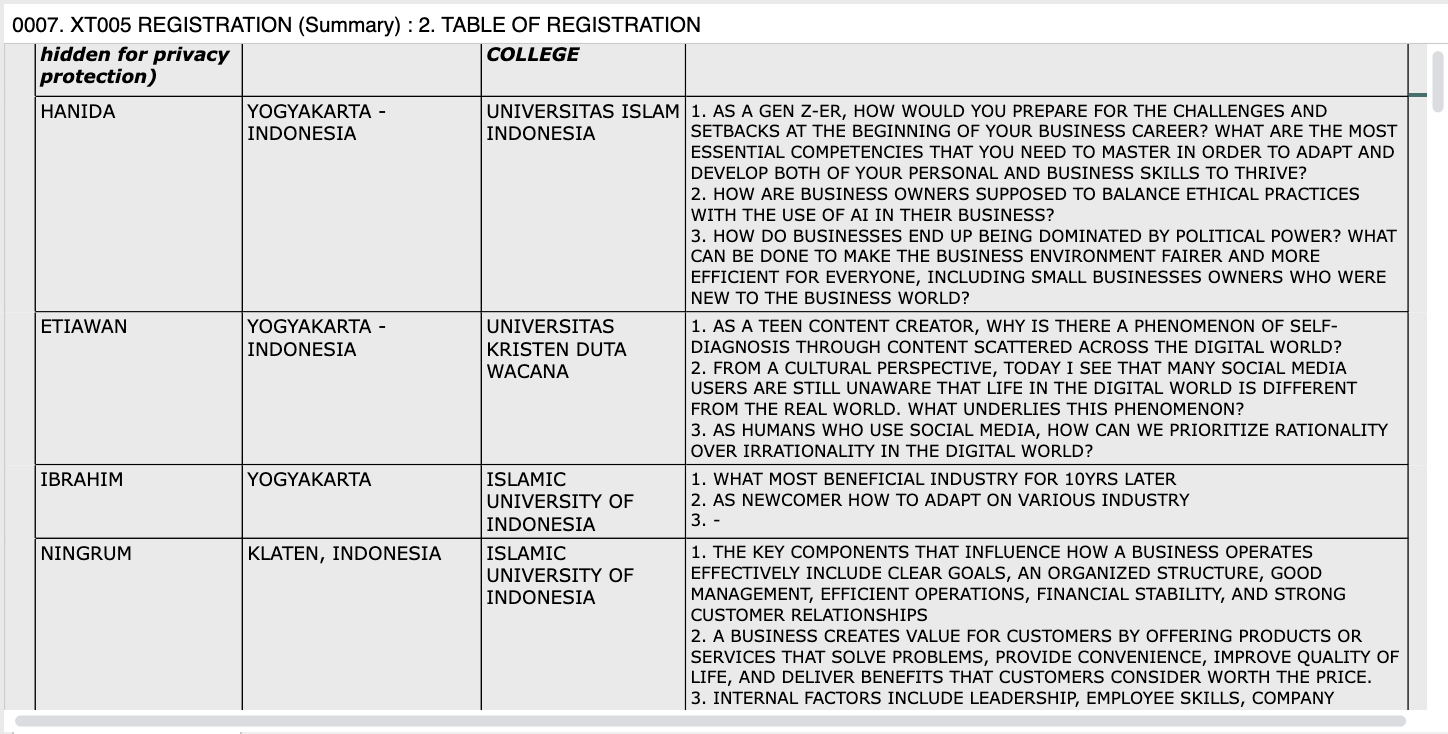
So that’s not entirely bad — we’ve already received four registrations. The questions submitted by the members are genuinely interesting and even a little surprising. They’re very different from the usual patterns we see.
We typically measure questions across three levels — what, how, and why — based on the Simon Sinek model. What’s particularly noteworthy is that these questions already reveal the mindset patterns beginning to form in their thinking.
Universitas Kristen Duta Wacana — Yogyakarta
1. Why is there a rise in self-diagnosis through digital content among teens?
The internet has turned into the world’s largest “symptom checker,” and teens are naturally curious explorers. When relatable creators describe anxiety, ADHD, or burnout, young viewers often see pieces of themselves reflected in those stories. Combine that with a fast-paced information stream and the human need for identity, and self-diagnosis becomes a shortcut — quick, convenient, and emotionally validating.
Of course, the risk is that short videos can’t replace real professional evaluation, but the emotional resonance makes them feel accurate.
2. Why are many social media users unaware that the digital world is different from the real world?
Digital culture blurs boundaries. Algorithms reward content that triggers emotion, not necessarily content that reflects reality. On top of that, people present polished versions of themselves online — like living in a highlight-reel universe. When you immerse yourself long enough, the digital “bubble” feels normal.
In other words, the digital world is designed to feel real… even when it isn’t.
3. How can we prioritize rationality over irrationality in the digital world?
Pause before reacting. A few seconds of breathing can turn an impulsive reaction into a thoughtful one.
Cross-check information. When something seems too shocking or too perfect, treat it as a friendly challenge to verify.
Follow creators who educate, not provoke. Curate your digital diet the same way you’d choose healthy food.
Set boundaries. Time limits, digital detox days, or “no-scroll mornings” help keep your mind grounded.
Rationality isn’t about being emotionless — it’s about steering your emotions instead of letting the algorithm do it.
Islamic University of Indonesia — Klaten
1. What components help a business operate effectively?
A strong business stands on a solid foundation:
Clear goals that guide direction
Organized structure so everyone knows their role
Good management that empowers people, not controls them
Efficient operations where resources aren’t wasted
Financial stability that keeps the business resilient
Strong customer relationships built on trust
When these pieces work together, a business runs like a well-tuned engine.
2. How do businesses create value for customers?
They focus on making life easier or better. A product or service is valuable when it:
Solves a real problem
Improves convenience
Enhances quality of life
Delivers benefits that feel worth the price
When customers feel “this makes my life better,” value is created.
3. What are the internal and external factors affecting business operations?
Internal factors come from within the company:
Leadership quality
Employee skills
Company culture
Operational efficiency
External factors come from the business environment:
Competition
Market trends
Economic conditions
Customer behavior
Government regulations
A successful business grows by strengthening its internal capabilities while adapting to external changes. By participating in these sessions, you’ll gain the insights and skills needed to go much further.
For Ibrahim
Ibrahim is asking the right questions — the kind that signal long-term thinking rather than short-term hype.
1. Most beneficial industry for the next 10 years
There’s no single winner, but there are clusters full of opportunity:
AI & automation
Sustainable energy & climate tech
Healthcare + biotech
Data & cybersecurity
Agritech & food systems
These areas solve real problems — which means they’re not going anywhere.
2. How a newcomer adapts across industries
The real superpower isn’t choosing the “right” industry — it’s becoming the kind of person who can thrive in any industry.
Key moves:
Learn how to learn fast
Build foundational skills (communication, tech literacy, problem-solving)
Stay curious, stay flexible
Observe how each field works before trying to “fix” it
If he masters adaptability, the industry becomes less important — because he becomes valuable everywhere.
For Ningrum
Ningrum’s answers show clarity, structure, and a very business-literate mindset. This is someone who already thinks like a manager.
Her understanding of business fundamentals is spot-on.
Clear goals, strong structure, solid management, smooth operations, stable finances, and customer trust — that’s the real backbone of any organization.
Her explanation of value creation is also accurate.
If a business doesn’t solve a real problem or make life easier, customers won’t care.
Her breakdown of internal vs. external factors is textbook quality.
Leadership, culture, skills — internal.
Competition, economy, customers, regulations — external.
She’s already thinking in the same categories professionals use when analyzing companies.
Our take?
Ningrum doesn’t need help understanding business; she needs challenges that stretch her thinking. She’s ready for more advanced topics like systems thinking, competitive strategy, and business model design.
Meanwhile from another channel , we were collecting some feedback for members who were excited to join in. But do read the Dunning Kügner effect chapter so you understand the hype cycle better.
Here are the thoughts :
Geofani – Love the philosophical curiosity! He’s basically asking, “How does the universe behave… and why are we humans so strange?” That blend of rational vs. irrational thinking is a great spark for deep mindset work.
Shinta – Simple, pure curiosity. Sometimes that’s the best fuel — no drama, just an open door and a willingness to step through.
Ridwan – Joined because of a friend — classic, and honestly underrated. Great things often start with a nudge from someone we trust.
Merissa – “Not much surprises” is hilarious in its own way. That’s the energy of someone who is observant, grounded, and maybe a little hard to impress… which makes breakthroughs extra fun.
Shuvaira – Surprised by her own open-mindedness — that’s always a cool moment of self-discovery. It’s like finding a hidden room in your own brain.
Puji – Already aware of her open-mindedness, which usually means she’s ready to engage deeply and adapt quickly. Strong foundation.
So those who are ready to cross over - Here comes the Brochure and its registration. Once again - do read the Dunning Kügner Effect Chapter and provide your feeds.

there are also. a few read me thoughts :
